Can a starter 1060 steel katana plus lesson bundle attract offline partners?
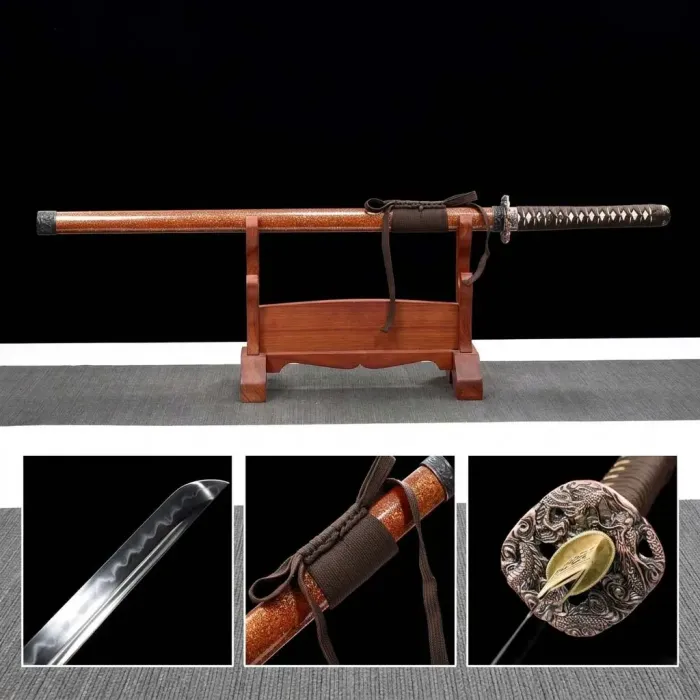
A age-old Japanese sword represents a splendid creation of artistry, but think you seek to express your own flair? Tailoring your blade is a enriching journey, allowing you to forge a truly rare piece. From the handle wrapping and clasp to the plate design and cutting motif, each element offers a chance for tailored look. This study delves into the territory of katana alterations, providing knowledge for both beginners and proficient enthusiasts desiring to make their signature on the time-honored art of the samurai.
Introductory Real Skill
For aspirants hoping to embark on the enriching journey of classical sword techniques , 1060 steel katanas bring an superb entry point. This defined grade of essential steel strikes a nice compromise between value and proficiency. While never as hard as upper-echelon steels, 1060 facilitates a moderate level of sharpening , making it perfect for newcomers to acquire the foundations of blade preservation and experience the grace of genuine Japanese weaponry. It’s a superb choice for fostering experience without the fiscal burden of more premium steels.
T Gear Steel Cutlasses: Combining Performance and Affordability
For hobbyists seeking an authentic sword experience without exceeding the budget , T10 alloy katanas represent a compelling option. These tools offer a noticeable improvement in durability compared to lower-grade alternatives, exhibiting decent edge retention and fair flexibility for rudimentary slashing techniques. While not rivaling the top-notch characteristics of superior steels like T100 or folded iron , T10 provides a notable blend of ability and price , making them a common choice for beginners and those on a narrow salary .
Exceeding the Sword : Modifying Your Katana's Attachments and Haft
Despite the sharpened blade is undeniably the important point of a katana, truly improving its presence lies in the careful customization of its elements and hilt . This practice allows devotees to exhibit their distinct style . Review the broad possibilities: menuki - decorative decorations that bring visual interest ; the hamon sheaths – often masterfully etched ; the tsuka basis itself, wrapped in authentic ito binding ; and the fusa knob , which can be crafted from various ingredients like precious metals or shell .
- Opt for patterns that match with you.
- Experiment with various components .
- Prioritize strength for a enduring mark .
The Charm of the Katana: Heritage, Workmanship, and Metal
Such Japanese sword contains a matchless allure, steeped in epochs of Asian history and tradition . More than merely a instrument of hostilities , it's a representation of the knight ethos – a fusion of competence and self-control . Its growth spanned plentiful generations, with early swords evolving into the sleek curvature and precise edge we recognize today. The creation involved is truly amazing , requiring eons of apprenticeship to attain . The process involves a complicated folding of pure iron , creating layers that enhance the cutting edge’s flexibility and hacking ability. Different schools of forging originated , each with their distinctive secrets and practices for achieving the ideal equilibrium and edge - a truly strenuous pursuit.
- First Katana classes
- The importance of the katana in warrior culture
- Ancient metalworking approaches
Choosing the Perfect Steel for Your Sword Project Project: 1060 vs. T10
Electing the appropriate steel is crucially important for any oriental blade project, and the resolution between 1060 and T10 can be delicate. 1060 is a well-known American composition, offering a solid balance of robustness and fortitude, enabling it reasonably easy to handle. However, T10, a East Asian steel, frequently boasts improved wear durability and can arguably achieve a more peak hardness, although it can be somewhat demanding to work with and requires refined heat modifying. Consider your custom katana capability and targeted characteristics: for a newcomer, 1060 may be a more origin, while the competent smith might value the enhanced qualities of T10.
- Ease of Operating
- Erosion
- Conclusive Strength
Revealing the Strength: Expert Katana Improvement Strategies
Refining the technique of katana adjustment extends far beyond basic sharpening. Serious connoisseurs are now probing advanced techniques to truly liberate a blade's hidden potential. This incorporates intricate work with the blade border, utilizing specialized compounds for differential annealing and carefully electing the shape of the crossguard to optimize balance and capability. Beyond purely functional adjustments, artisans are increasingly focused on generating unparalleled aesthetic grace, through complex embossing and layered polishes that truly transform a katana into a work of art.
Transforming Basic Steel into Art: Building a 1060 Sword
The journey launches with standard 1060 fabrication , a durable material far absent the beautiful katana it will mature into . Master bladesmiths execute a involved process of stacking and shaping the rough steel, repeatedly heating it and striking it to purify impurities and form a balanced grain structure. This laborious process, often persisting for cycles, builds the essential hardness and flexibility characteristic of a real Japanese edge . Further heat procedures , including methodical hardening and annealing , are essential to achieve the aimed balance of sharpness, life and loveliness .- Uniting: Removes impurities and develops grain structure.
- Forming: Fabricates the steel into the initial blade form.
- Tempering: Decides the final hardness and flexibility.
The Continuing Pull of the Katana: Comprehensive Review of Metalwork and Tailoring
Each traditional katana stays a captivating symbol embodying Japanese custom , its enticement far surpassing mere combat tools . Forged from unique steel and commonly featuring intricate decorations , the approach of creation itself is a honored art. Beyond the central craftsmanship, the ability to reshape a katana - from the patterning to the tsuka wrapping and habaki - enables for a genuinely individual embodiment for both admirers and wielders alike. This fusion of long-established steelwork and boundless personalization produces the katana's continued fame across the earth .